Best Substack alternative: why beehiiv beats Ghost and Kit
This article contains affiliate links. We may earn a commission on qualifying purchases at no extra cost to you. Our recommendations are independent and research-driven, and we say when a pick is not hands-on.
beehiiv is our pick for anyone leaving Substack, and it wins on the two things Substack gets wrong: a flat monthly fee instead of a 10% cut of every paid subscription, and built-in growth tools, including a recommendations network, instead of hoping the algorithm notices you. Ghost is the runner-up for writers who want to own the whole stack and don't mind running it. Buttondown is the budget pick for a small list that just needs to ship, and Kit is the choice if you sell products and courses alongside a newsletter. Prices checked October 2026. We weighed cost at realistic list sizes, fees on paid subscriptions, migration effort, audience growth tools, design control, and how much technical work lands on you. This comparison is research-driven, not hands-on.
| Role | Tool | Why |
|---|---|---|
| Pick | beehiiv | the only option that grows the list for you with referrals, recommendations, and an ad network |
| Runner-up | Ghost | the best choice when owning the site and the membership revenue matters more than growth tooling |
| Budget pick | Buttondown | lean, exportable, and inexpensive for a small list that just needs to ship |
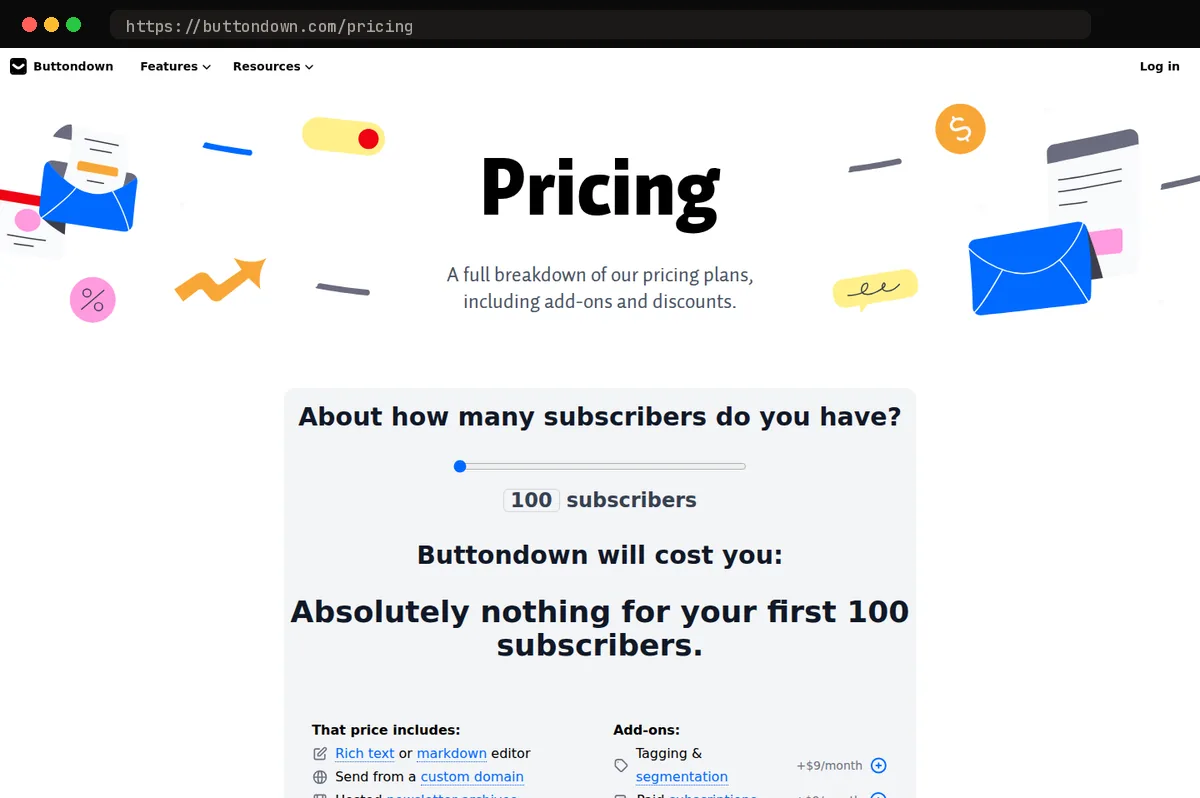
- ButtondownBasicFree: for the first 100 active…$9/moUp to 1,000 active subscribers
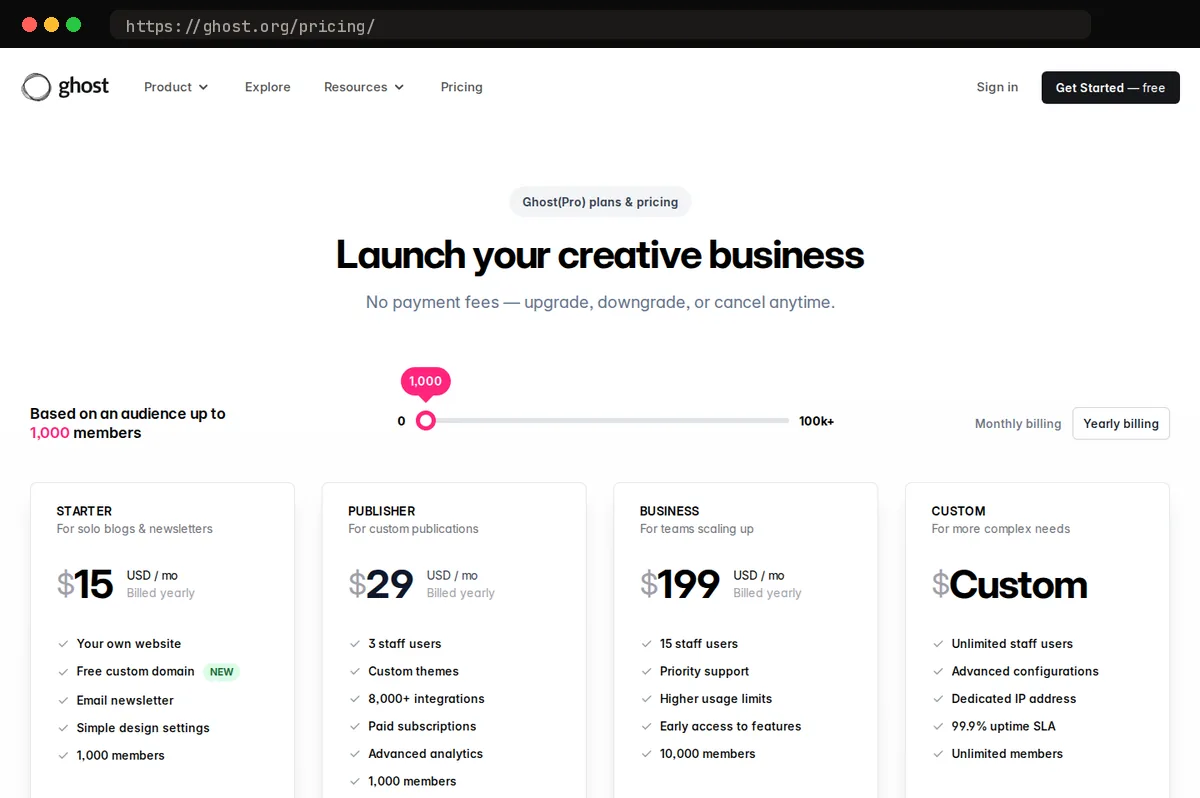
- GhostStarter*$18/mo*Up to 1,000 members, 1 staff user managed hosting)
- beehiivLiteFree: Launch/Free: up to 2,500…$59/moOur pickUp to 1,000 subscribers at this price
How the best Substack alternative options compare
Prices checked October 2026.
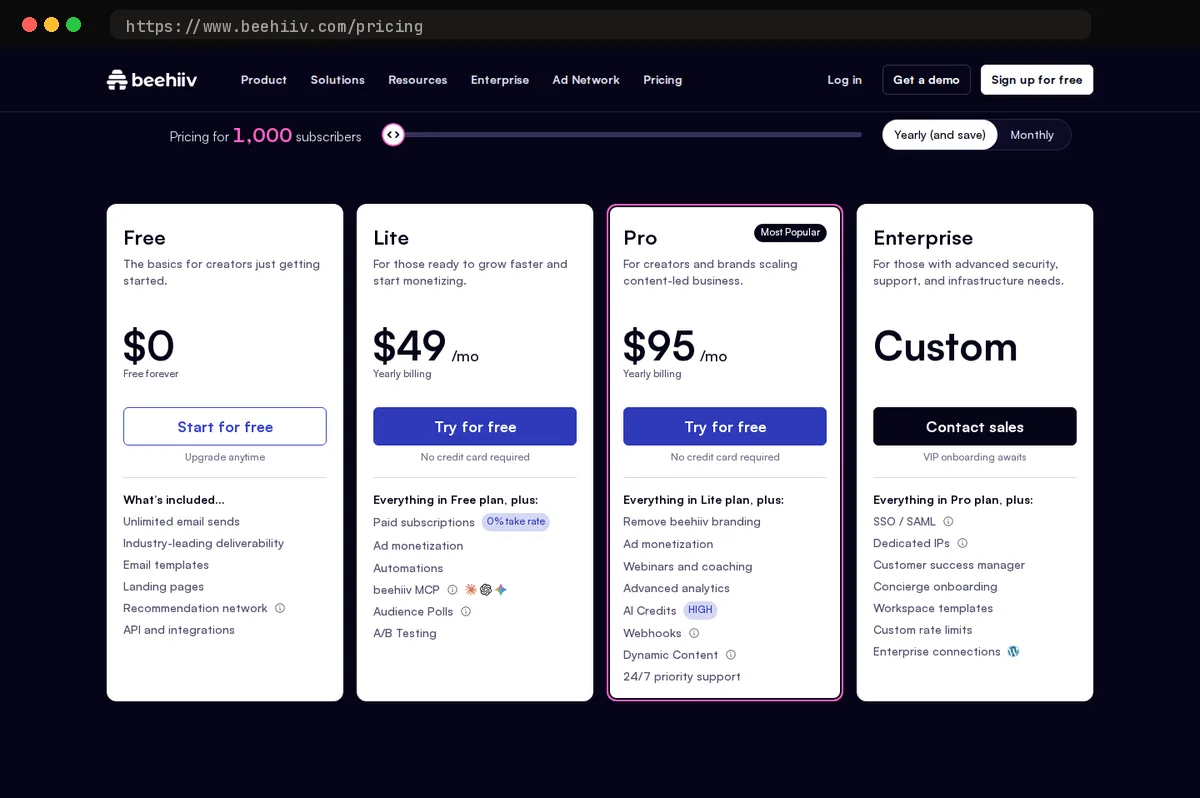
beehiiv is our pick because it fixes the two things Substack buyers complain about most: Substack takes a share of paid subscription revenue (10%), and it gives you almost no control over design, audience data, or growth mechanics. beehiiv charges a flat plan fee instead (Free, formerly Launch, costs nothing up to 2,500 subscribers; Lite, formerly Scale, starts at $59 a month, or $49 a month billed annually, for up to 1,000 subscribers), and it ships a reader referral program, cross-publication recommendations, and real segmentation out of the box.
Ghost is the stronger choice if the newsletter is secondary to a website you want to own and theme; it is open source and self-hostable, but email is a feature, not the product. Kit wins on automation sequences for creators selling products, and Buttondown suits writers who want Markdown, an API, and nothing else. This verdict is research-driven, not a hands-on test.
Why writers leave Substack
A free list of ten thousand readers costs nothing on Substack. Convert a few hundred of them to paid and the platform takes a cut of every renewal: 10% of paid subscription revenue, plus Stripe's processing fee (2.9% + $0.30 per transaction, plus Stripe Billing's 0.7% recurring-payments fee on pay-as-you-go pricing). Writers notice once they do the math against a flat plan priced by list size: the better the newsletter does, the worse the deal gets.
The second complaint is control. Design stops at a logo and a color, and the subscriber record is a name, an email, and a paid flag. Custom fields, tags, and behavior-based segmentation are sparse, and automation goes little beyond a welcome email. A drip sequence for new subscribers, a win-back for lapsed paid readers, or a separate cadence for a second audience all require leaving.
The third is the network. Substack's recommendations and app feed route readers to other Substacks, which grows Substack's ecosystem more reliably than it grows the writer's own domain. Exporting a list moves the emails but not the recommendations, comments, or search presence.
beehiiv, Ghost, Kit, and Buttondown each fix a different subset. beehiiv is our pick because it keeps a growth loop closest to Substack's while charging by list size and returning design and segmentation to the writer. Ghost leans toward ownership, Kit toward automation, Buttondown toward cost. The right one depends on which of those four complaints is the one you're actually paying for.
Growth tooling: referrals, recommendations, and paid recommendations
beehiiv is the only one of the four built around acquiring readers rather than just publishing to them. The referral program, cross-newsletter recommendations, and the paid recommendation marketplace all live inside the editor. A writer can set reward tiers, drop the referral block into an issue, and recommend other newsletters without touching an integration or a spreadsheet. The referral program is gated to a paid tier (Lite and above; Lite allows 3 milestones, Pro and Enterprise are unlimited, and it is not on Free), so confirm the plan before you count on it. Our pick rests on this as much as on anything else in the comparison.
Ghost covers the basics well. Its native signup embed is clean, and recommendations between Ghost sites work the way you'd expect. What it lacks is a referral engine: if you want readers rewarded for sharing, you're bolting on a third-party tool and reconciling subscriber data yourself.
Kit's answer is the Creator Network and its recommendation swaps. They work well when you already have an audience worth trading on; a list starting near zero has little to offer a partner, so the loop runs slowly at first.
Buttondown stays deliberately minimal: tidy signup forms and an API, nothing that resembles a growth marketplace. That's a feature for writers who find growth mechanics tiresome, and a gap for everyone else.
If list growth stalled on Substack and that's why you're leaving, weigh this section heavily. Substack's recommendation network is genuinely strong, and only beehiiv replaces it with tooling that goes further.
Monetization: paid subscriptions, ads, and sponsorships
Stripe-backed paid tiers are table stakes across beehiiv, Ghost, Kit, and Buttondown, so the real question is what each platform adds on top of a monthly subscription.
beehiiv is our pick here because it is the only one of the four that will sell your audience for you. Its ad network matches sponsors to newsletters by audience profile and size, and the writer's job shrinks to approving placements and hitting send. For a mid-sized free list that would never convert enough paid subscribers to matter, that turns an otherwise unmonetized audience into recurring sponsorship income without cold outreach, rate cards, or invoicing.
Ghost is the cleanest option for a pure membership business. You get tiers, gated posts, member-only email, and a full member portal, and Ghost takes no cut of subscription revenue beyond the hosting plan you already pay for. Stripe's own processing fee still applies.
Kit leans toward creator commerce: digital product sales, tip jars, and paid recommendations sit alongside subscriptions, which suits writers who sell courses or templates as much as they sell access.
Buttondown handles paid subscriptions competently and stops there. For its audience of small, technical lists, that narrow scope is a feature, not a gap.
If sponsorship income without doing sales matters, weight beehiiv. If you are running a membership and nothing else, weight Ghost.
Editor, design, and site ownership
Ghost has the deepest site toolkit of the four. It is a full publishing platform first: a themed, custom-domain website with real SEO controls, structured archives, and an open-source core you can self-host if you want the database on your own server. The newsletter is one output of a site the writer owns outright. If the published page matters to you as much as the inbox, or you are moving a large back catalog that needs clean URLs and redirects, Ghost deserves a careful look here even though it is not our overall pick.
beehiiv, our pick, comes at it from the other direction. Its editor is modern and quick, with native polls, referral blocks, and ad placements, and the hosted site is good enough for most newsletters: a readable archive, a custom domain, and basic SEO fields. It is a newsletter product with a website attached rather than the reverse, and that is the right tradeoff for writers whose growth happens in the inbox. The site is a credible landing spot, not a publication-grade CMS.
Kit's editor is functional and its landing pages and forms are strong, which suits creators selling something. The long-form reading experience on a Kit-hosted page is a step behind both Ghost and beehiiv.
Buttondown favors a plain, text-first editor with a plain archive page. Writers who like composing in a text editor find it liberating; writers who want layout control find it spartan.
Automation, segmentation, and integrations
Kit has the deepest automation of any tool here, and the gap is not close. Its visual automation builder chains triggers, delays, tags, and conditional branches on a canvas, and tag-based segmentation lets you send one email with different blocks for different readers. The integration catalog is long enough that Kit behaves more like a lightweight marketing platform than a newsletter tool. That depth is why course creators, coaches, and anyone selling through a multi-step sequence often end up on Kit regardless of its other shortcomings.
beehiiv, our pick, has closed most of the practical distance. Automations handle welcome sequences, re-engagement flows, and tag- or behavior-triggered sends; segments cover the usual splits by engagement, signup source, and subscription status; and beehiiv advertises a native API for pushing subscribers in from your own stack without a middleman. Automation availability and limits vary by plan (custom automations start on Lite with 10 live automations and 10 segments; Pro and Enterprise are unlimited; Free has no live custom automations and 3 segments), so check that before assuming it is on the tier you are buying. For a publisher whose business is the newsletter itself, this is enough, and it comes bundled with the growth tooling Kit lacks.
Ghost's segmentation is built around membership tiers and labels, and anything conditional generally runs through Zapier or webhooks you maintain yourself. Buttondown offers automations as a paid add-on ($29 a month) alongside a well-documented API and webhooks; it is lighter than Kit's visual builder, which developers appreciate and everyone else may find limiting.
If you publish a straight weekly issue, you will rarely notice Kit's advantage. If you sell through sequences, you will notice it the first week.
Migration from Substack and long-term lock-in
The mechanical move is the easy part. beehiiv, Ghost, Buttondown, and Kit all accept Substack's subscriber CSV; beehiiv, Ghost, and Buttondown also import the post archive, while Kit imports subscribers only and past posts must be recreated by hand as Broadcasts. Budget an afternoon, plus a few days of watching deliverability settle on a new sending domain.
The harder question is the one most writers skip: what happens the next time you want to leave. Here the four tools split into two camps.
Ghost is the least sticky. The subscriber list, the posts, the theme, and the software itself are all exportable, and you can self-host the whole thing, so leaving Ghost's hosted service does not even require leaving Ghost. Buttondown is a close second: everything exports in full, and its API reaches every object in the account, so a scripted exit is straightforward.
beehiiv and Kit export subscribers and content cleanly, but the parts that compound over time are proprietary. beehiiv's recommendation network, referral program, and paid recommendations (formerly Boosts) live inside beehiiv. Kit's automations and tagging logic do not translate to another tool without being rebuilt. You leave with the list and the words; you leave behind the machinery that grew the list.
For most writers that trade is acceptable, and it is the trade beehiiv asks in exchange for doing more than any tool here to grow a paid audience. It is still worth naming before committing that audience to any platform.
At a glance
| Tool | Strengths | Tradeoffs |
|---|---|---|
| beehiiv | Built-in referral program, recommendation network, and ad marketplace; modern editor; native automations and API; strongest growth loop of the four. | Website and design controls are thinner than Ghost; growth features are proprietary so the compounding value is platform-bound; higher tiers get pricey as lists scale. |
| Ghost | Full publishing platform with themes, custom domain, and SEO; open-source and self-hostable; no platform cut on membership revenue; cleanest member portal. | No referral or sponsorship engine; automation limited to tiers and labels plus webhooks; self-hosting shifts maintenance to the writer. |
| Kit | Best visual automations and segmentation; Creator Network for recommendation swaps; digital product sales and tip jars; large integration catalog. | Long-form reading experience and archive are weaker; feels like a marketing tool rather than a publishing home; pricing is list-size driven. |
| Buttondown | Fast, text-first editor; full exports and a well-documented API; minimal lock-in; indie pricing that stays low for small lists. | No growth marketplace or referral tooling; plain archive and limited design; automations are a paid add-on ($29/month) and lighter than Kit's visual builder. |
Bottom line
Our pick is beehiiv. It gives a newsletter the growth tools Substack withholds: built-in referral mechanics, a recommendation network, and real audience analytics, on a flat monthly plan instead of a cut of every paid subscription (Free: $0, up to 2,500 subscribers; Lite: from $59 a month, or $49 a month billed annually, up to 100,000 subscribers; Pro: from $109 a month, or $95 a month billed annually, up to 250,000 subscribers; Enterprise: custom; Lite and Pro prices rise with list size). For a writer who intends to grow a list and own the relationship with readers, that trade favors beehiiv.
The main caveat is discovery. Substack's app and network hand new writers readers from day one; beehiiv's recommendation network is smaller, so you bring your own audience or build one through social and SEO. If free discovery matters more to you than ownership and margin, Substack still has a case.
Related guides
This article contains affiliate links. We may earn a commission on qualifying purchases at no extra cost to you. Our recommendations are independent and research-driven, and we say when a pick is not hands-on.
Test Picked Editorial
Edited by Adam Ryan. Gear picks come from equipment running in his own homelab and workshop. Software picks are researched comparisons.


